7 Best Work Management Tools for Hospitality Teams in 2026
Hospitality does not run on a nine to five. It runs on shift handovers, pre-opening checklists, surprise VIP arrivals, and a dozen departments that all need to know the same thing at the same time.
Most work management tools were not built for that. They were built for software teams shipping features in two week sprints, then sold to everyone else. Which is why so many hotel and F&B operators end up back where they started: WhatsApp groups, Excel trackers, and a general manager who knows everything because nobody wrote anything down.
The good news is that the market has matured. In 2026 there are genuinely good options, and a few of them understand multi-property operations.
In this article, we will break down the seven best work management tools for hospitality teams, what each one is actually good at, and how to pick without regretting it in six months.
What Hospitality Actually Needs From a Work Management Tool Before the list, it helps to know what you are grading against. Hospitality has requirements that generic project management software rarely covers:
Repeatable templates. A hotel pre-opening is not a one-off project. It is the same 400 tasks, run again at the next property. If you rebuild it from scratch each time, the tool is costing you money.
Multi-property structure. Corporate needs visibility across the portfolio. Each property needs autonomy over its own operations. Very few tools handle both without becoming a mess.
Non-desk usability. Your housekeeping supervisor, your F&B floor manager, and your engineering lead are not sitting at a laptop. If it is not usable in thirty seconds on a phone, it will not be used.
Communication in context. A comment on the task beats a message in a group chat that nobody can find on Thursday.
Accountability you can audit. When a licence renewal is missed, you need to know who owned it and when it slipped, not who shouted loudest in the group.
Keep those five in mind as you read.
1. Taskworld
Taskworld is a work management platform with an unusually deep footprint in hospitality, including Accor and Dusit, and it was designed around exactly the structure hotel groups need.
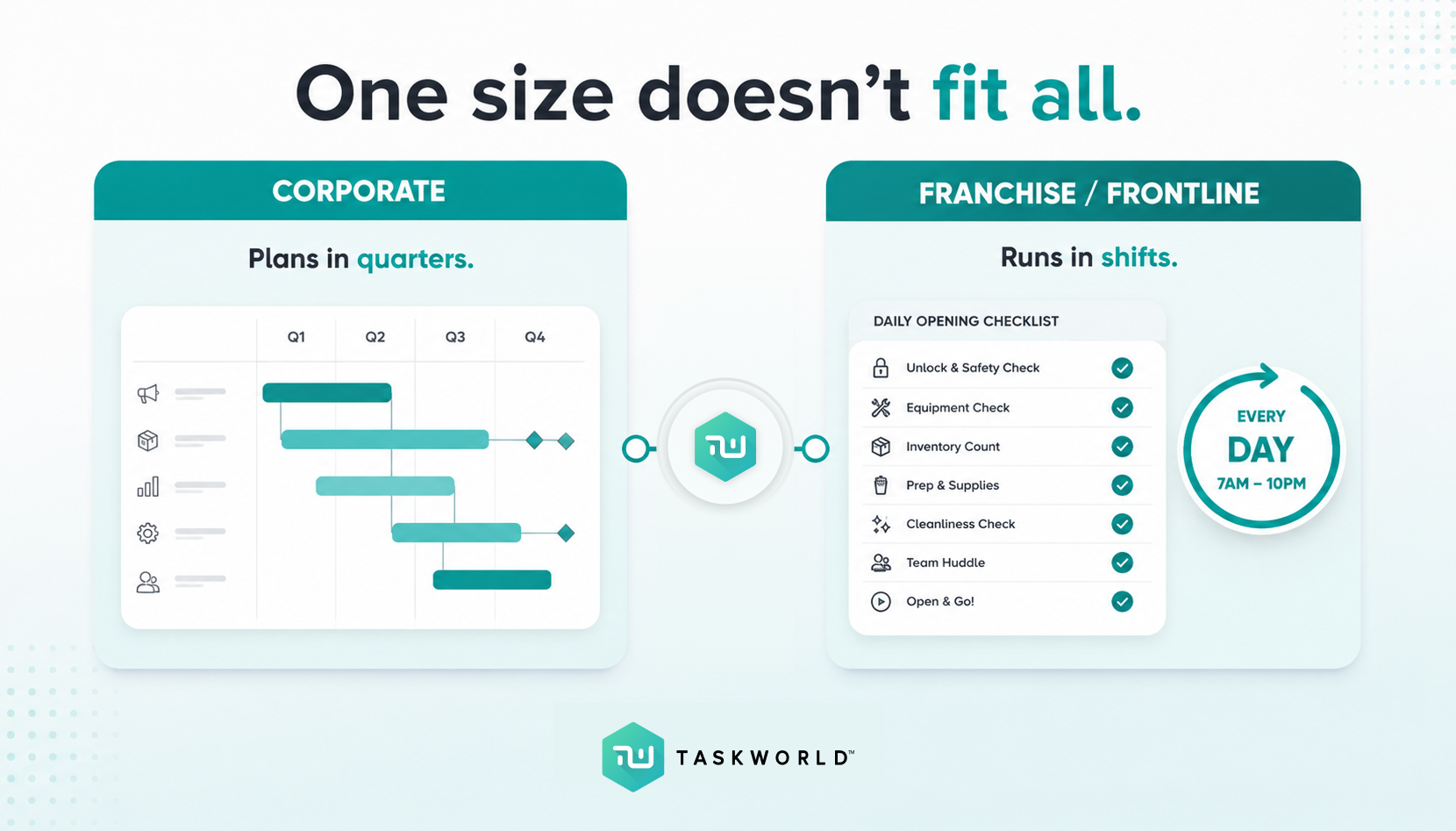
Its HQ and business unit model lets corporate set standards and see across every property while each hotel still runs its own boards. Pre-opening and pre-shift workflows can be saved as templates and redeployed at the next property, which is where most of the time savings come from. Dusit reported getting back 40% of their time after moving off spreadsheet-based pre-opening tracking.
Chat lives directly on tasks rather than in a separate app, so context does not get lost between the message and the work. Enterprise customers get a dedicated customer success manager, which matters more than it sounds when you are rolling out to a property with forty staff and mixed digital confidence.
Best for: Hotel groups, multi-property operators, and F&B chains that need standardization without stripping properties of autonomy.
2. Asana
Asana is a polished, widely adopted platform with strong workflow automation and reporting. It handles cross-functional projects well and its portfolio view is genuinely useful for leadership.
Where it gets harder is operational shift work. Asana is built around projects with an end date, and hospitality operations are largely continuous. Teams often end up bending it to fit, and the more capable tiers get expensive quickly once you add every property.
Best for: Corporate and marketing functions inside a hospitality group, less so the properties themselves.
3. Monday.com
Monday is highly visual and highly customizable, which is both the appeal and the catch. You can build almost any workflow you want, and that flexibility makes demos look fantastic.
The trade-off is that someone has to own that build. Without a dedicated internal admin, boards drift, every property does it differently, and the standardization you wanted evaporates.
Best for: Groups with an ops or IT person who will genuinely own and maintain the setup.
4. ClickUp
ClickUp packs an enormous amount into one platform: docs, goals, time tracking, whiteboards, and more. For teams that want to consolidate several subscriptions, the breadth is attractive.
That breadth is also its weakness in hospitality. Frontline staff facing that many features and views tend to disengage fast. Adoption is the whole game in this industry, and complexity is the enemy of adoption.
Best for: Tech-comfortable teams that want everything under one roof and will invest in training.
5. Trello
Trello is the easiest tool on this list to start using. Kanban boards, drag and drop, almost no learning curve. For a single restaurant or a small boutique property, it can be enough.
It runs out of road at scale. Reporting is thin, cross-property visibility is limited, and holding a whole group together on Trello usually means a lot of manual stitching.
Best for: Single sites and small independent operators.
6. Wrike
Wrike is built for structured, process-heavy work, with solid request forms, approvals, and resource management. Renovation projects, capex work, and compliance workflows suit it well.
The interface is dense and the setup effort is real. It rewards teams with a project management culture already in place, and frustrates teams without one.
Best for: Capital projects, refurbishments, and central PMO functions.
7. Smartsheet
Smartsheet gives spreadsheet-fluent teams a familiar grid with real project management underneath. If your operation currently lives in Excel, the transition feels natural.
The flip side is that it still feels like a spreadsheet, and grids are a poor fit for a supervisor checking tasks between covers on a phone.
Best for: Finance-adjacent and analytical teams migrating away from Excel.
How to Choose Without Regretting It
The most common mistake is picking on feature count. The tool with the longest feature list is rarely the one your team actually opens on a Saturday night.
Grade against adoption instead. Run a pilot at one property, not across the group. Give it a real workflow such as a pre-opening or a pre-shift handover, and see whether frontline staff use it without being chased. If they do not touch it in two weeks, no amount of functionality will rescue the rollout.
Then check whether it scales the way your business does. If you plan to open three properties in the next two years, ask how the tool handles property number four. If the answer is "you rebuild it", keep looking.
Get those two things right and the rest is detail.
Streamline Hospitality Operations with Taskworld
From pre-opening checklists to daily shift handovers, Taskworld helps hotel and F&B teams standardize what works and see across every property in real time.