Taskworld vs. the Rest: A Work Management Platform Comparison in 2026
Choosing the right work management platform is one of the most consequential decisions a growing organization can make. Fragmented tools, siloed communication, and opaque project statuses cost companies thousands of hours every year. With dozens of project management tools on the market, the choice can feel paralyzing, so we've done the hard work for you.
The modern enterprise needs more than a to-do list in the cloud. It needs a unified work management platform that delivers clarity across teams, alignment between headquarters and every business unit, and the execution power to turn strategy into results. After rigorously evaluating the five most-adopted tools: Taskworld, ClickUp, Microsoft Project, Asana, and Monday.com. One platform consistently rises above the rest in enterprise-grade usability, security, and real-world impact.
Try now for free
Why Most Project Management Tools Fall Short at Scale
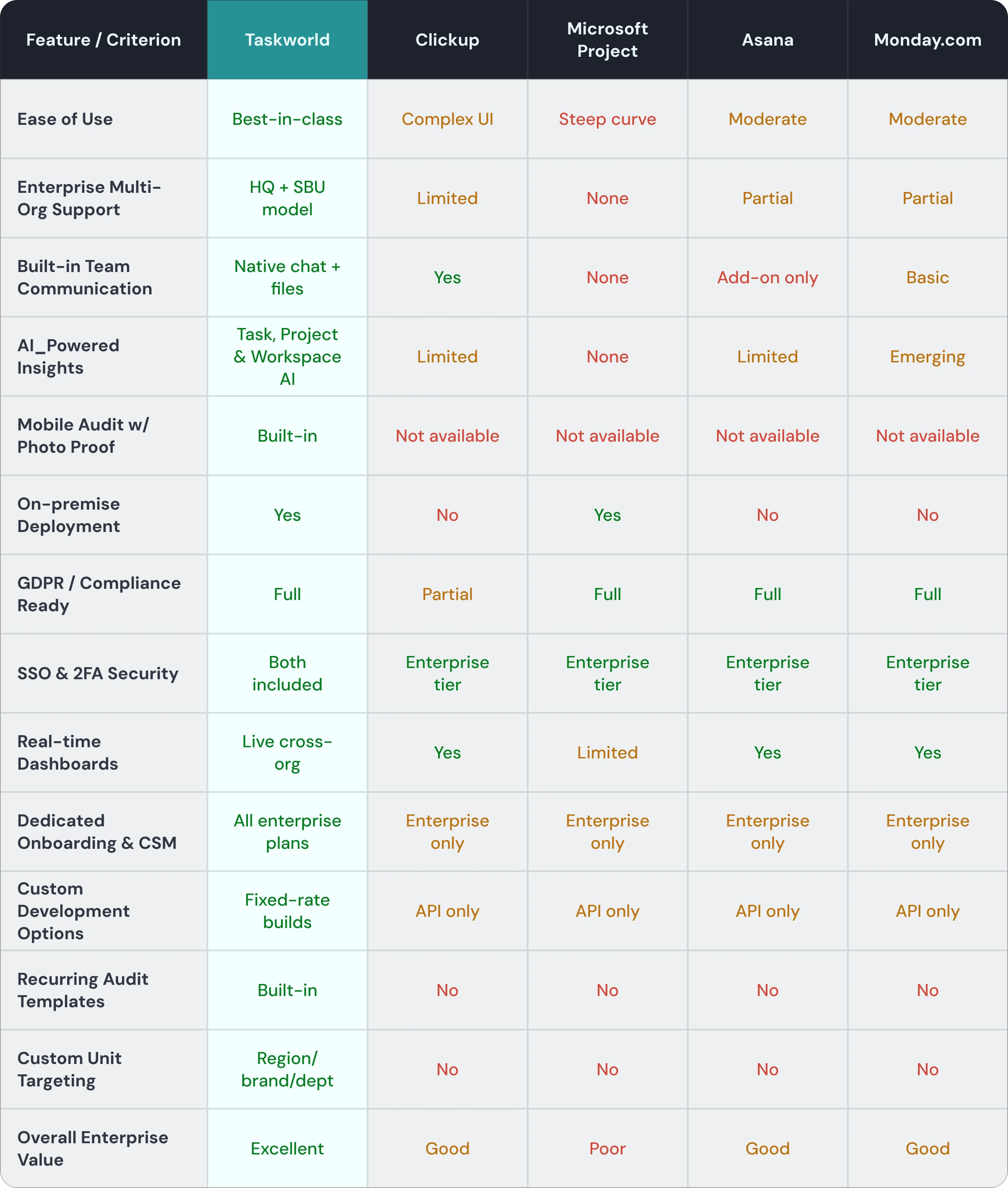
ClickUp has earned a reputation as a feature-rich project management tool, but its very depth is also its Achilles' heel. New users report steep onboarding curves, cluttered interfaces, and performance issues that worsen as workspaces grow. Microsoft Project remains the gold standard for traditional Gantt-heavy project management, but it is a relic of desktop-era thinking: expensive, rigid, and notoriously difficult to roll out to non-technical staff. Asana is polished and popular, yet it struggles with cross-departmental visibility and lacks robust built-in communication features, forcing teams to bolt on Slack or email. Monday.com offers a colorful, board-centric work management platform that works well for small teams but becomes administratively cumbersome as enterprise complexity grows with pricing that escalates sharply at scale.
Taskworld: Built for the Way Enterprises Actually Work
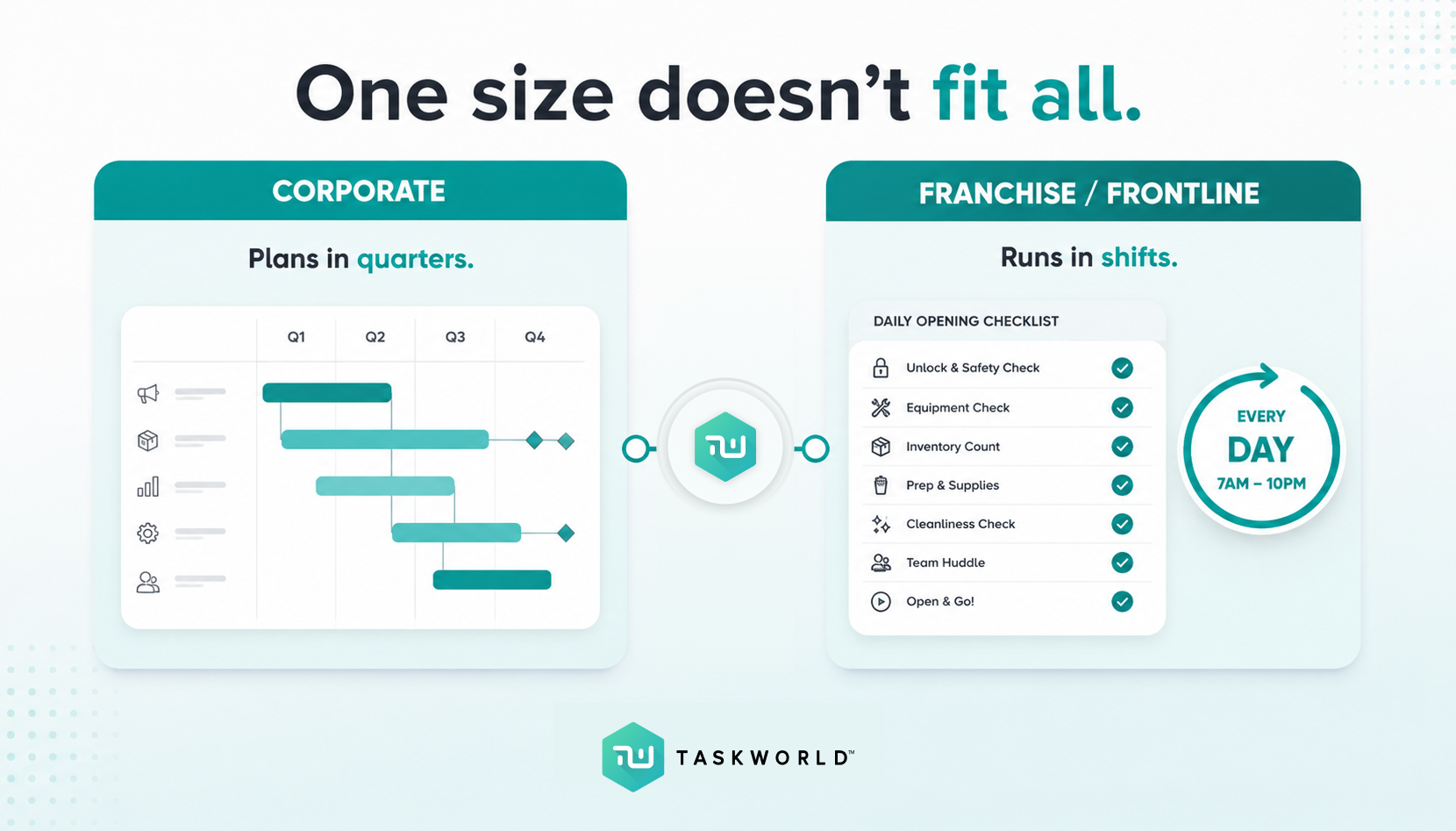
Taskworld was architected from the ground up as an enterprise-first project management tool, not a startup tool that retrofitted enterprise features as an afterthought. Its headquarters-plus-strategic-business-unit (SBU) model allows global organizations to coordinate processes, audits, and milestones centrally while tailoring execution at the branch or franchise level. The platform's Custom Unit Targeting lets managers push specific projects to the right teams using filters like region, brand tier, or department, eliminating the "one-size-fits-all" initiative sprawl that plagues organizations on Monday.com or Asana. Crucially, Taskworld integrates real-time AI-powered insights, live dashboards, built-in team chat, mobile audit capabilities with photo proof-of-work, and a dedicated Customer Success Manager, features that collectively make it the most complete work management platform available today.

Taskworld vs. the Competition
Evaluating the five leading project management tools across the criteria that matter most to enterprise teams.
Taskworld Is the Work Management Platform Built for Scale
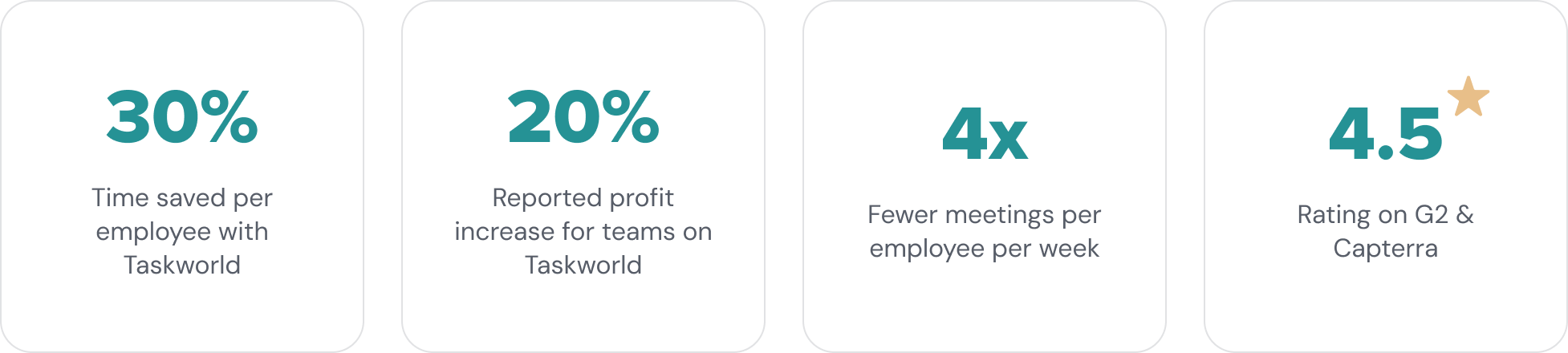
When evaluated across real enterprise requirements, multi-org coordination, security, ease of adoption, AI intelligence, mobile capability, and dedicated support, Taskworld is the clear winner. ClickUp and Monday.com are competent for small-to-mid-sized teams but buckle under enterprise complexity. Microsoft Project is powerful on paper yet increasingly irrelevant in a mobile-first, collaborative world. Asana is elegant but narrow in scope. Taskworld, by contrast, is the only project management tool that combines an enterprise-grade architecture with the simplest onboarding experience on the market, a 4.5-star user rating, and a proven track record across hospitality groups, financial institutions, automotive networks, healthcare systems, and global franchise chains. If your organization is serious about achieving clarity, alignment, and execution at scale, Taskworld is not just a strong choice, it is the smart one.
See Taskworld in Action
Discover how enterprise teams streamline execution, improve visibility, and align every department in one unified work management platform.