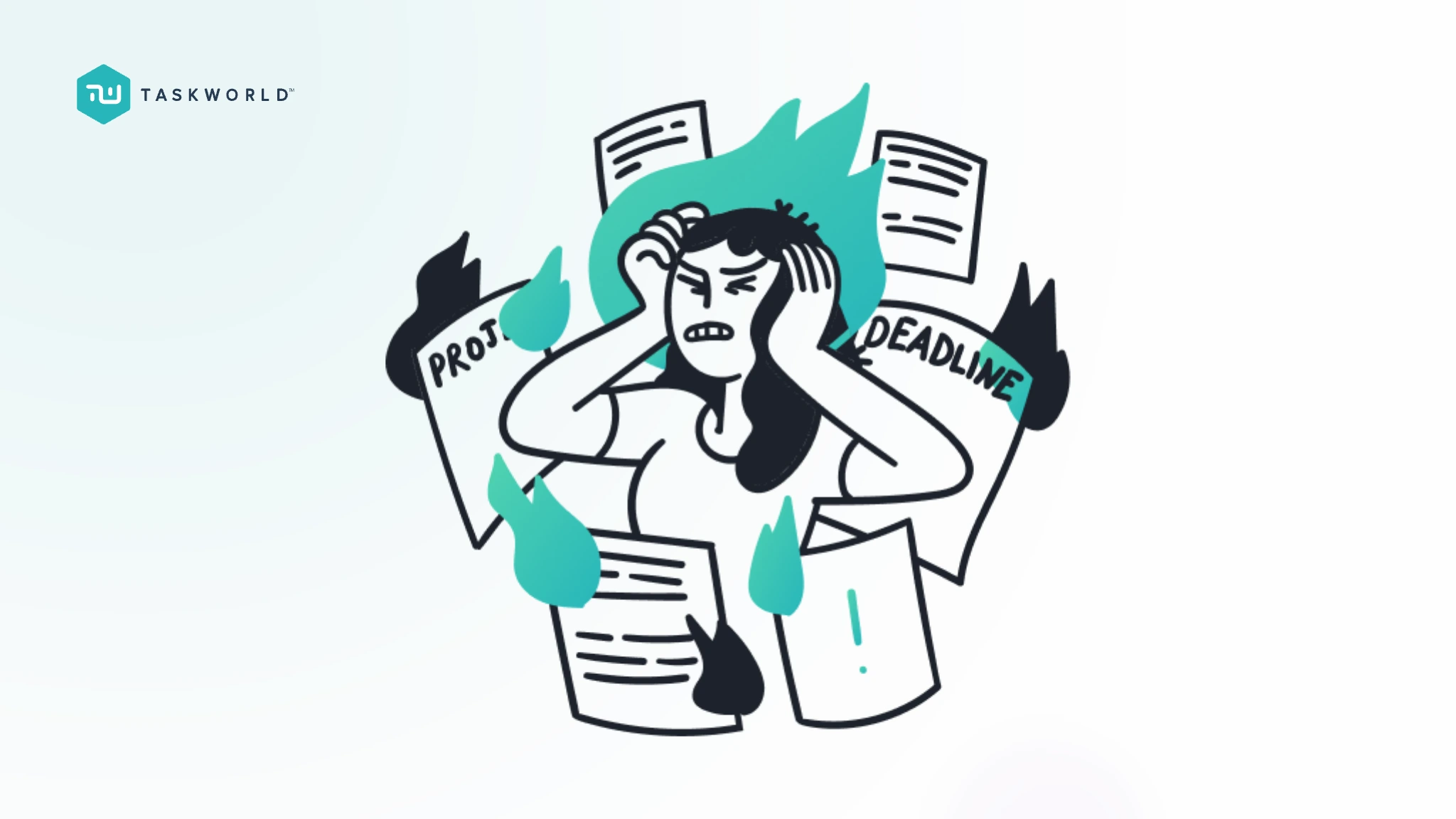
Parkinson's Law Is Real: 6 Ways We Fight It in Our Own Work
Give a team two weeks to produce a one-page brief, and you will get a one-page brief in two weeks. Give the same team two days, and you will usually get the same brief, sometimes a better one.
That is Parkinson's Law: work expands so as to fill the time available for its completion. The British naval historian C. Northcote Parkinson coined it in a 1955 essay for The Economist, after noticing that the British Colonial Office kept hiring more staff even as the empire it administered shrank. Fewer colonies, more administrators. The work had simply grown to fill the people and hours available to it.
Most productivity advice treats this as something that happens to other companies. It is not. We run a work management platform, we write about deadlines for a living, and we still catch ourselves letting a task breathe for a full week because the calendar said it could.
So instead of another explainer, here is the honest version: the six habits we actually use to fight Parkinson's Law inside our own team, including the ones that took us a few failures to get right.
Why This Matters More Than It Sounds
Parkinson's Law is not really about laziness. Nobody sits idle for the extra week. The time gets filled with genuine-feeling work: a fourth revision nobody asked for, a formatting pass, an extra alignment call, a Slack thread debating a word choice.
That is what makes it hard to spot. The team is busy the whole time, the output looks polished, and the calendar is full. The cost is invisible because it never shows up as a missed deadline. It shows up as everything taking slightly longer than it should, forever.
Multiply that across a department and you get the version Parkinson originally described: an organization that keeps growing its inputs without growing its results.
1. We Set the Deadline Before We Estimate
The instinctive order is to estimate the work, then set the date. We reversed it. We ask what the honest deadline should be if the work went well, then we scope to fit.
This sounds like pressure. In practice it does the opposite: it forces the conversation about what is actually essential to happen at the start, when it is cheap, instead of in the final week when someone has already built the thing nobody needed.
2. Every Deadline Belongs to a Person, Not a Project
A due date on a project is a suggestion. A due date on a named person's task is a commitment. We learned this the slow way, from projects where the end date was clear and every step leading to it was ambiguous.
Now the rule is simple: if a due date exists, someone's name is next to it. Shared ownership of a deadline reliably becomes nobody's ownership of it.
3. We Break Long Tasks Into Interim Checkpoints
Research from Dan Ariely and Klaus Wertenbroch at MIT found that students who set evenly spaced self-imposed deadlines across a semester outperformed those working toward a single end-of-term deadline. The single deadline group had more freedom and did worse with it.
We treat any task longer than a week as suspicious. Not because long work is bad, but because a distant finish line gives Parkinson's Law all the room it needs. Breaking it into checkpoints removes the empty middle stretch where work quietly expands.
4. Meetings Default to 25 Minutes, and Have to Earn 50
Meetings are where Parkinson's Law is most visible, because the container is so obvious. A 60-minute slot produces 60 minutes of discussion regardless of the agenda.
Our default invite is 25 minutes. Anything longer needs a reason in the invite itself. The surprising part was not the time saved. It was that shorter meetings produced clearer decisions, because there was no room to circle.
5. We Ask "What Would This Look Like at Half the Time?"
This is our favourite question, and it is not rhetorical. When something is scoped at four weeks, we genuinely sketch the two-week version.
Sometimes the two-week version is worse and we keep the original plan, now with a clear reason. Often the two-week version turns out to be 90% of the value, and the missing 10% was the part nobody outside the team would ever notice. Microsoft Japan ran a version of this at company scale in 2019, cutting to a four-day week and reporting a roughly 40% jump in productivity per employee.
6. We Look at Where Time Actually Went
Fighting Parkinson's Law on instinct alone does not work, because the whole problem is that expanded work feels productive while it is happening.
So we look back. Which tasks consistently take longer than estimated? Which ones are always finished on the final day, never earlier? That second pattern is the fingerprint of Parkinson's Law, and you can only see it in the data, never in the moment.
The Takeaway
Parkinson's Law is not defeated once. It is a default that reasserts itself the moment you stop paying attention, on every new project, in every new quarter.
The good news is that the fix is structural rather than motivational. You do not need a more disciplined team. You need tighter containers: shorter default timeboxes, deadlines attached to people, checkpoints instead of distant finish lines, and an honest look at where the hours went.
That last part is the one most teams skip, and it is the one that makes the rest stick. Visibility into who owns what, when it is due, and how long it truly took turns Parkinson's Law from an invisible tax into something you can actually manage.
If your team is running on scattered spreadsheets and end-of-project deadlines, Taskworld brings task ownership, milestone planning, time tracking, and workload analytics into one place, so the pattern becomes visible before it costs you a quarter.
Start Using Your Time Better
See where your team's hours are really going, and give every deadline a clear owner. Book a walkthrough of Taskworld with our team.